
If you’ve spent any time on social media, in a gym, or listening to a fitness podcast lately, you’ve probably heard someone talking about peptides. BPC-157, TB-500, “the Wolverine peptide”; the names get thrown around like they’re common knowledge.
Maybe a training partner mentioned it after a nagging shoulder injury. Maybe you saw a podcast clip promising faster recovery, better sleep, or a sharper edge as you get older. Have you found yourself wondering if you’re missing out on something everyone else already knows about?
Here’s a straight answer: what peptides are, why the interest has exploded, what’s actually backed by evidence, and what it might mean if you’re one of the many men considering trying them.
What Peptides Actually Are
Peptides are short chains of amino acids. The body makes more than 7,000 of them naturally; they act as signaling molecules, hormones, and growth factors that regulate everything from blood sugar to tissue repair (UCHealth Today).
Some peptides are already well established medicine. Insulin is a peptide. So are GLP-1 drugs like Ozempic and Wegovy. Both went through the full FDA approval process: large clinical trials, proven safety data, and dosing that’s actually dialed in (UCHealth Today).
What’s new is the explosion of interest in a different category. Peptides like BPC-157, TB-500, and KPV are being marketed as near cure-alls, touted for tissue repair, anti-aging, and energy, despite a much thinner evidence base (UCHealth Today). One sports medicine physician quoted by UCHealth summed it up simply: peptides are scientifically interesting, but “promising” and “proven” are not the same thing (UCHealth Today).
What the Three Most Popular Peptides Are Actually Reviewed For
BPC-157, TB-500, and KPV were among seven peptides the FDA’s Pharmacy Compounding Advisory Committee (PCAC) reviewed in July 2026. Each was tied to one specific, narrow proposed use (FDA).
Here’s where the gap between what was reviewed and what’s being marketed becomes clear:
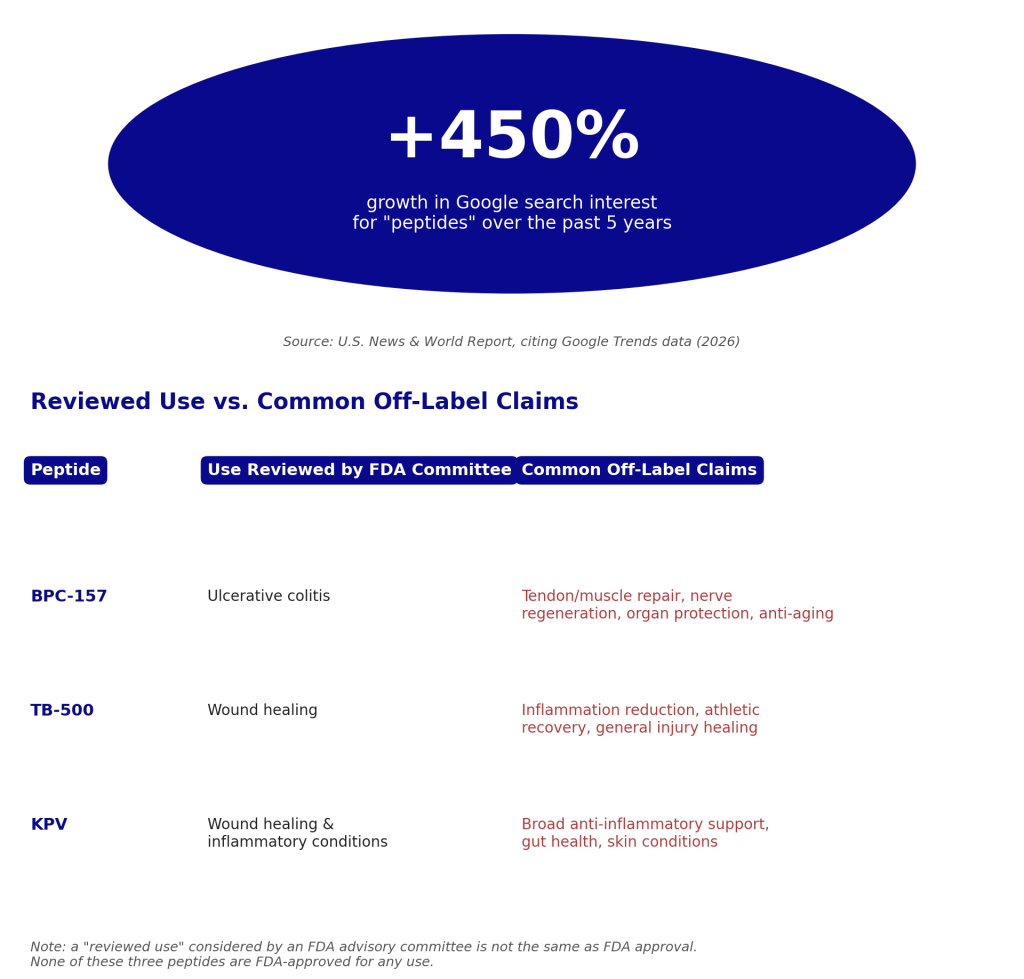
BPC-157, nicknamed the “Wolverine peptide” after the X-Men character known for near instant healing, was reviewed for a proposed use in ulcerative colitis. Its purported benefits, which go well beyond that, span healing ulcers, aiding muscle and tendon repair, regenerating nerves, countering neurodegeneration, and shielding organs from injury (UCHealth Today).
TB-500 was reviewed for wound healing. It’s also being widely used off label to reduce inflammation and speed injury recovery, particularly among athletes (UCHealth Today).
KPV was reviewed for wound healing and inflammatory conditions. It’s picked up a following for broader anti-inflammatory and gut health claims that go beyond that review (UCHealth Today).
Worth sitting with: a use reviewed by an advisory committee is not the same as an FDA approved use. None of these three peptides are approved for the broader purposes actually driving demand.
Why Everyone’s Suddenly Talking About This
The interest isn’t random, and it’s measurable. Google Trends data shows search volume for peptides has surged more than 450 percent over the past five years (U.S. News & World Report).
In July 2026, the FDA’s Pharmacy Compounding Advisory Committee voted to recommend several peptides, including BPC-157, KPV, and TB-500, for a list of bulk substances certain compounding pharmacies may use (U.S. News & World Report).
That news spread fast, and a lot of people read it as approval. It isn’t. As one physician told U.S. News, the recommendation concerns future compounding access, not scientific validation, and the FDA hasn’t made a final decision (U.S. News & World Report).
There’s more worth knowing here, and it complicates the story further:
- The committee’s votes were narrow, decided 8 to 6 on BPC-157 (AJMC).
- The panel went against FDA’s own career scientists, who had recommended against including any of the seven peptides, citing short, underpowered studies (AJMC).
- FDA found no human safety studies at all for KPV or TB-500. The limited BPC-157 studies tracked small groups of patients for no more than fifteen days, even though the conditions being proposed for treatment are typically chronic (Health Affairs Forefront).
- Half of the committee’s twelve voting members represent companies that offer peptide therapies (UCHealth Today).
Does that change how you’d read the next headline claiming a peptide just got “FDA backing”?
Can a Doctor or Clinic Legally Offer These Right Now?
This is the part a lot of marketing glosses over, and it matters if you’re deciding whether to walk into a clinic offering peptide injections.
The Legal Pathway, In Plain Terms
For a compounding pharmacy to legally prepare a peptide like BPC-157 for a patient, the substance generally has to be listed on the FDA’s Section 503A Bulks List, and a licensed prescriber has to write a prescription for that specific patient (FDA).
As of the July 2026 vote, BPC-157, KPV, and TB-500 are not yet on that list. The committee only voted to recommend them, and that recommendation isn’t binding. The FDA still has to complete its own formal review (U.S. News & World Report).
A Fairness Question Worth Knowing About
Independent reporting found that the committee’s makeup had shifted toward members with financial or professional ties to telehealth and peptide-related businesses that stand to benefit from wider access, and that some “yes” votes came from members representing companies expected to profit from broader prescribing (TIME).
Put simply: any clinic offering BPC-157, TB-500, or KPV injections today is operating ahead of a confirmed, finalized legal compounding pathway. That doesn’t automatically mean a given provider is doing something illegitimate. It does mean the ground is still shifting, and it’s worth doing homework before you’re the one on the table.
How to Tell If a Provider Is Doing This the Right Way
A few concrete things worth asking or checking before agreeing to any peptide treatment in a clinical setting:
- Ask about the prescription chain. Is the peptide dispensed through a specific prescription, filled by a named, state licensed compounding pharmacy, rather than sourced from an unnamed supplier?
- Ask what condition it’s actually targeting. Does it match what’s been reviewed for that peptide, or is it a broad wellness pitch?
- Ask about follow-up. A legitimate treatment plan involves monitoring over time, not a single injection and a receipt.
- Be skeptical of unusually low pricing. It often reflects skipped quality and sourcing controls, not a good deal.
- Check licensing directly with your state medical board, rather than relying on the clinic’s own website.
The Pros and Cons, Honestly
What’s Genuinely Promising
There’s real biology behind some of the excitement. A literature and patent review of BPC-157 published in a peer reviewed scientific journal describes the compound’s beneficial effects in preclinical models covering tissue injury, inflammatory bowel disease, and central nervous system disorders, with a favorable safety profile in those models (National Center for Biotechnology Information).
For men who’ve tried conventional treatment for a chronic injury and hit a wall, that kind of research can feel like hope.
Where the Evidence Actually Stands
The gap between animal studies and human proof is significant. The same review notes that BPC-157 hasn’t been approved by the FDA or any global regulatory authority, due to a lack of sufficient clinical studies confirming benefits in humans (National Center for Biotechnology Information).
A rat tendon healing in a lab is not the same as a human tendon healing after surgery; that’s the honest gap in the research right now, and it’s the reason most physicians interviewed on this topic describe themselves as pro-evidence rather than anti-peptide or pro-peptide.
The Real Risks
Because these products are largely unregulated and often sourced online, there’s no reliable way to verify purity. UCHealth physicians warn that products bought this way can contain heavy metals, unlisted medications, or other unsafe substances (UCHealth Today).
Reported side effects across peptide use include fluid retention, insulin resistance, headaches, joint symptoms, and changes in blood pressure or lipid levels, since these compounds can disrupt broader hormone pathways (Advisory Board). A Harvard trained physician interviewed by Advisory Board noted that growth hormone related therapies, including many peptides, can affect multiple hormone pathways at once, not just the one they’re marketed for (Advisory Board).
BPC-157 and TB-500 are both on the World Anti-Doping Agency’s banned substance list, and both are also banned by the U.S. military (UCHealth Today).
What’s Really Driving the Draw
Here’s the part that matters most from a mental health perspective. A lot of the pull toward peptides isn’t really about the peptides.
Consider a composite example, drawn from patterns that show up often in men’s mental health work, not any one real client: a man in his 40s tears his rotator cuff. Physical therapy is slow going, and six months later he’s still not back to where he was. He starts hearing about peptides from a training partner. Within a week he’s ordered a vial online.
What’s actually happening there often has less to do with the shoulder than it looks. It’s the frustration of feeling like his body is betraying him, the fear that this is the start of decline, and the discomfort of sitting with a slow, uncertain recovery timeline when he wants control back now.
That pattern shows up again and again, in different forms:
- Control-seeking after helplessness. Chronic pain or aging anxiety often comes with a sense that nothing is working. A peptide protocol offers something concrete to do about it, even when the evidence for that action is thin.
- Optimization culture. Biohacking reframes self-improvement as engineering the body rather than doing the slower, less visible work of addressing sleep, stress, or emotional strain.
- Distrust of institutions. For some men, an unregulated “insider” solution feels more appealing than a conventional one, even when it carries more risk.
Ask yourself: if the injury weren’t involved, what would you actually be sitting with right now?
None of this makes the interest irrational or something to be ashamed of. It usually means there’s a real problem underneath: pain that hasn’t resolved, fear about aging or performance, or frustration with feeling stuck. The peptide becomes a stand in for solving that problem, rather than the problem itself getting addressed.
Guidance and Recommendations
If you’re considering peptides, a few things are worth sitting with first.
Talk to a physician before using anything injectable, especially something sourced online without regulation or oversight. The risk of contamination and unknown interactions isn’t worth guessing about.
Ask yourself honestly what you’re actually trying to fix. Recovery, energy, and reduced inflammation, the things peptides promise, are often achievable through sleep, resistance training, nutrition, and stress management. Slower, yes, but backed by real evidence and without the unknown risks.
Notice if the interest is part of a larger pattern. If you find yourself constantly chasing the next supplement, protocol, or biohack, that pattern is worth examining on its own, separate from whether any one product works.
When to Talk to a Therapist First
If what’s driving your interest in peptides is really about fear of aging, frustration with your body, feeling like you’ve lost control, or the sense that nothing else has worked, that’s worth talking through with a therapist before you try anything.
Sometimes the real issue isn’t in your tissue or your hormones; it’s in how you’re relating to pain, control, and self worth. Addressing that directly tends to bring more lasting relief than any injectable ever could.
If that sounds like where you’re at, reach out. A conversation with a therapist costs a lot less than a peptide protocol, and it might get you closer to what you’re actually looking for.
Sources: U.S. Food and Drug Administration (FDA.gov), U.S. News & World Report, UCHealth Today, National Center for Biotechnology Information (NCBI), Advisory Board, Health Affairs Forefront, AJMC (American Journal of Managed Care), TIME.
 S.Pace's PsychoHealth Blog